Tell iced coffee, cold brew and iced Americano apart by method
Three black cold drinks can look similar while beginning with different preparation methods. Serving temperature alone does not establish identity. Learn the main construction of iced coffee, cold brew and iced Americano, then check additions and the actual serving rather than infer sweetness, caffeine or flavour from the name.
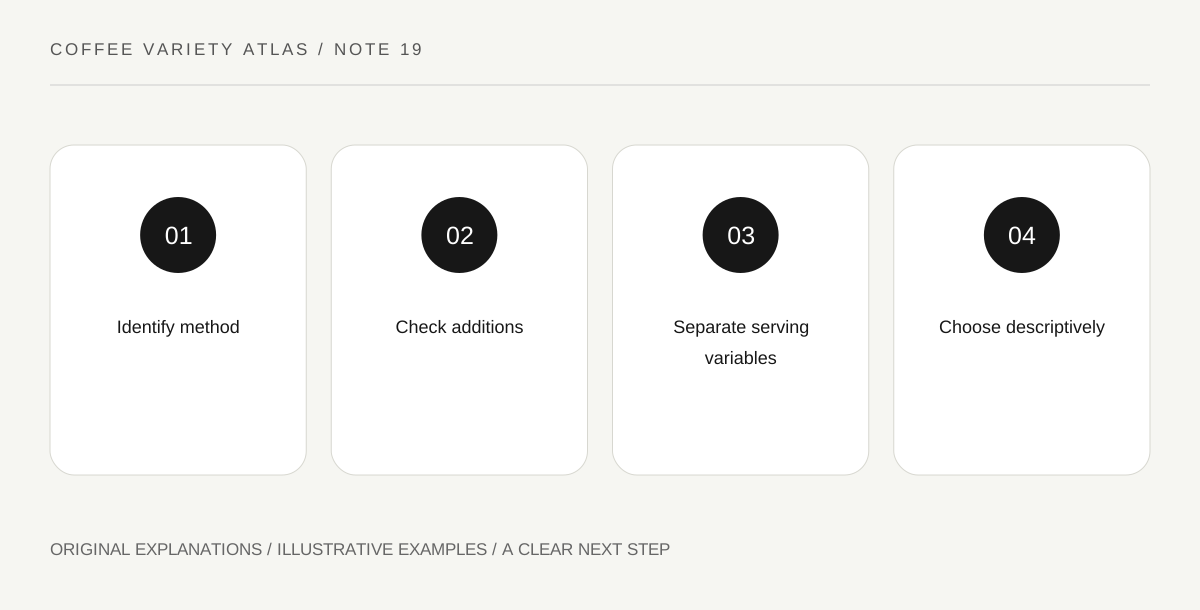
Original explanatory diagram. Read the full method and limitations below.
Use method as the first distinction
Iced coffee commonly begins as hot-brewed coffee that is cooled or served over ice. Cold brew is extracted using cool or cold water over a longer period. An iced Americano begins with espresso combined with water and ice. A café operator’s description supplies the actual implementation.
Draw three routes ending at a cold cup. The shared temperature belongs at the end, while the different methods belong earlier. This prevents the common assumption that any coffee served cold is cold brew. The diagram teaches identity without providing a home recipe or storage procedure.
Keep serving additions in a separate field
A cold drink may be served plain or include milk, sweetener, flavouring or foam. Defaults vary by operator and can change. Check the current menu description rather than assume that iced coffee is always sweetened or cold brew is always unsweetened.
A dark appearance does not establish absence of additions, and a creamy texture may have several causes. Ask what the product actually contains. Dietary and ingredient questions require accurate product information, not visual guessing or a broad statement about a drink category.
Avoid caffeine and flavour shortcuts
The name alone does not provide a serving-specific caffeine amount. Coffee dose, preparation, dilution and portion size vary. A larger cold brew or a darker iced Americano cannot be ranked reliably from appearance alone. Use actual product information when the amount matters.
Likewise, method can influence flavour without guaranteeing one universal profile. An operator may describe its cold brew as smooth or chocolatey, but that description belongs to its product. You can prefer any of the methods, and your experience of one does not establish how every coffee made that way must taste.
Clarify what you want from a cold drink
If you want an espresso-based black drink, say so. If you want the café’s cool-extracted product, ask for its cold brew and check any default additions. A descriptive request is useful when names are unfamiliar or several menu variants share a similar photograph.
For an exercise, sort fictional drink descriptions by method, additions and serving. Then identify which information remains missing. The exercise should not drift into brewing ratios, ice calculations or safety-critical storage advice. Its purpose is to make a menu choice understandable through the actual route from coffee to cup.
When reading a bottled product, look for its production description as well as the serving suggestion. A photograph of ice explains how it may be served; it does not establish whether the coffee was extracted hot or cold.
Illustrative cold-menu sorting
A fictional menu lists cold brew with optional milk, iced brewed coffee served plain and iced Americano. A reader sorts them by cool extraction, hot brewed coffee and espresso base. They check sweetener separately and leave caffeine unknown because the menu does not give it. Similar colour and temperature no longer make the three entries interchangeable.
Practical checks
Optional checkboxes save only in this browser.
Questions that come up
Is cold brew simply yesterday’s hot coffee chilled?
No. The term describes a cool- or cold-water extraction approach. Chilled hot-brewed coffee belongs to a different preparation route even when served at the same temperature.
Is cold brew always more caffeinated?
The category alone does not settle that. Actual coffee amounts, dilution and serving size vary. Compare the specific products’ information rather than rely on a universal ranking.
References and scope
These sources support the factual background. Examples and exercises are original illustrative teaching material. References do not imply endorsement.
- Starbucks: Espresso explained — A café operator’s examples of espresso, Americano and espresso-and-milk drink construction; recipes are operator-specific.
- Starbucks: Iced Americano, cold brew and iced coffee — Distinguishing drink identity by brewing method rather than serving temperature alone.
- National Coffee Association: Varieties — Origin and multiple production factors affect coffee descriptions; single origin can refer to different geographical scales.