Ask the right questions when choosing a flat white or cortado
Flat white and cortado often signal a smaller espresso-and-milk experience than a large latte, but names and serving practices vary. Learn to ask about espresso amount, total size and milk texture. Those details are more useful than assuming one universal ratio or treating either name as a guarantee of intensity.
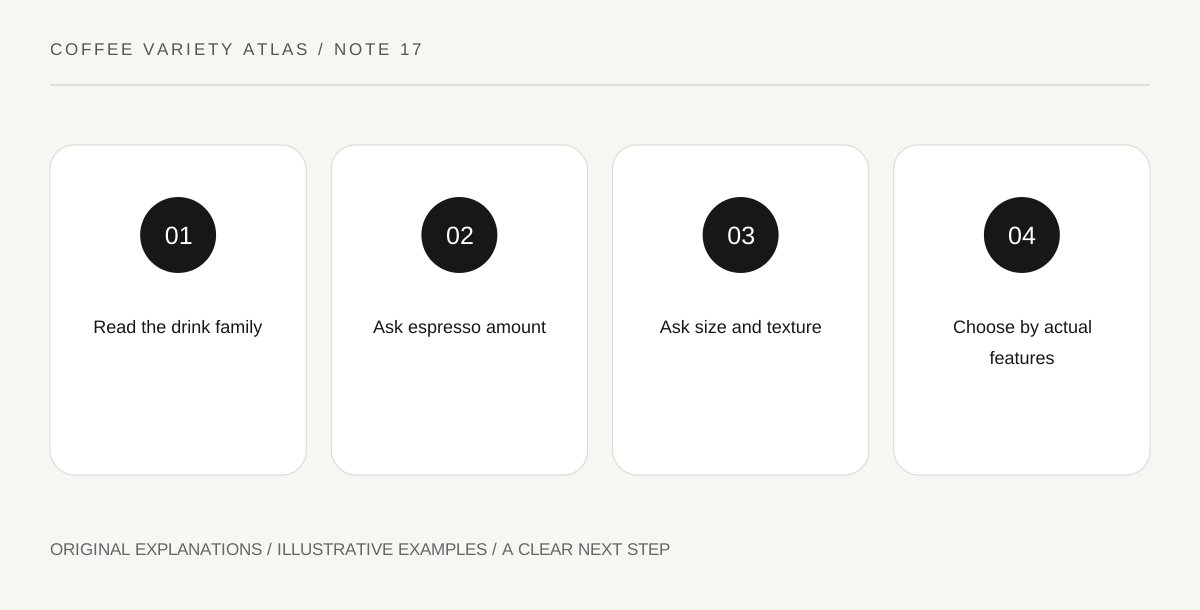
Original explanatory diagram. Read the full method and limitations below.
Use the name as an opening description
Both drinks belong to the broad family combining espresso with milk. Individual cafés distinguish them through serving size, espresso preparation and milk treatment. Some operators use ristretto components in particular drinks; that is an implementation detail to check rather than a rule that every café shares.
Draw a simple card with three blank fields: espresso component, total serving and milk texture. Fill it from the actual menu or a barista’s explanation. This gives you a practical comparison even when the names are used differently from a café you visited elsewhere.
Keep small size separate from coffee dose
A smaller cup can have a concentrated coffee-to-milk impression, but its total espresso amount is not established by size alone. A larger drink may use more espresso, the same amount or another recipe. Ask before turning cup dimensions into a caffeine or dose conclusion.
The word strong can confuse the exchange. You may want a more coffee-forward taste, more espresso or simply less milk. Name the property you mean. The café can then explain which available drink fits rather than guess what you associate with a particular name.
Ask about the milk experience
A smooth fine-textured milk layer and a more visibly foamy texture produce different experiences. Ask how the café handles the drink rather than infer texture from a photograph. A decorative surface can conceal differences in the liquid beneath it.
If you use an alternative milk, ask whether the same recipe or texture is expected. The actual ingredient and preparation matter more than the name printed above them. This guide does not rank milks or offer dietary advice; it helps identify what will be in the specific beverage.
Allow regional and operator variation
Drink names travel and adapt. You can prefer one preparation without declaring every different version illegitimate. Clarification is especially useful in a new café, where the operator’s menu is the relevant description of the product being offered.
For an exercise, compare fictional flat-white and cortado cards with their three fields filled differently. Choose based on the features you want, then explain the decision without relying only on the label. This builds portable menu literacy: even if a name changes meaning, you can still ask about the actual components.
Keep the menu wording alongside your notes. If a second café uses the same name for a different size, the two entries remain understandable because you preserved the operator’s description instead of treating your first encounter as a universal definition.
Illustrative three-field comparison
A fictional café offers a flat white and a cortado with different serving sizes and milk amounts. A customer asks about the espresso component rather than assume the smaller cup has more caffeine. They want less milk and choose the cortado after the explanation. Another café may use different proportions, so the customer keeps the questions rather than treating this example as a universal recipe.
Practical checks
Optional checkboxes save only in this browser.
Questions that come up
Is a flat white always made with ristretto?
Some operators use that approach, but do not assume every café does. Ask about the actual espresso component when it matters to your preference.
Is a cortado always exactly half coffee and half milk?
That is a common simplified description, but serving practices vary. Use the café’s recipe and size information rather than impose an exact ratio on every menu.
References and scope
These sources support the factual background. Examples and exercises are original illustrative teaching material. References do not imply endorsement.
- Starbucks: Espresso explained — A café operator’s examples of espresso, Americano and espresso-and-milk drink construction; recipes are operator-specific.
- Starbucks at Home: Latte macchiato — A primary example of latte macchiato as a milk-forward layered preparation.
- National Coffee Association: Varieties — Origin and multiple production factors affect coffee descriptions; single origin can refer to different geographical scales.