Read anaerobic as a fermentation condition rather than a complete coffee identity
Anaerobic describes limited or absent oxygen during a fermentation stage; it does not tell you the whole story of a coffee. Ask what material entered the stage, what happened afterward and whether anything was added. Keep the production description distinct from a guaranteed flavour or an assumption about ingredients.
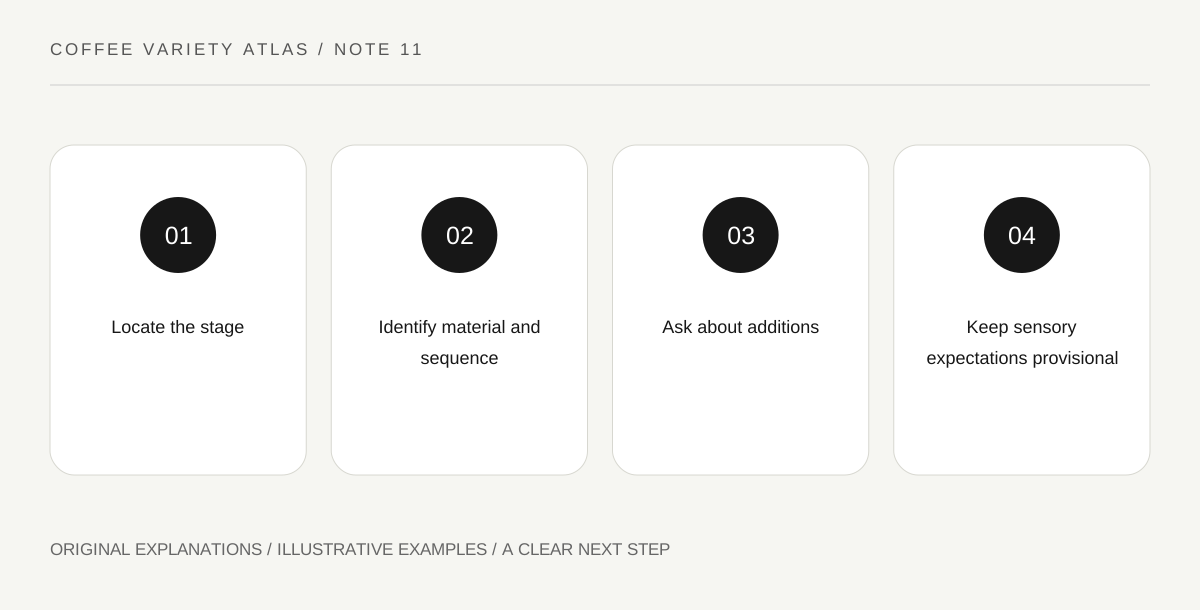
Original explanatory diagram. Read the full method and limitations below.
Place the term inside a larger sequence
The Specialty Coffee Association’s research discussion treats anaerobic fermentation as one of several processing developments and emphasizes the complexity of stages and conditions. The word alone does not specify whether whole fruit, pulped coffee or another material was involved, nor how the coffee was subsequently dried.
Draw a timeline with harvest, fermentation-related stage, drying, roasting and preparation. Place the word anaerobic beside the relevant stage rather than use it to replace the entire timeline. This makes room for a label such as anaerobic washed, where two terms can describe different aspects of the same lot.
Ask about the material and sequence
A useful producer description identifies what was fermented and how that stage connects to later handling. It may also describe selected microorganisms or another controlled variable. Read what is actually stated without assuming every producer uses the same vessel, duration or protocol.
This article is label education, not a fermentation recipe. A sealed container is not by itself a complete or safe processing system. Do not transfer a consumer-facing description into an improvised food or agricultural experiment merely because the terminology sounds simple.
Separate added materials from sensory notes
A fruit-like note does not prove fruit was added, while a detailed process may explicitly include additions. The SCA’s identity discussion shows why transparency about these distinctions matters. Ask a direct question when additions are relevant to your decision instead of infer them from the strength of an aroma.
Likewise, fermented or wine-like language does not establish the final drink’s alcohol content or ingredient list. Sensory resemblance and composition are different questions. Use the actual product information for ingredients and avoid a universal claim that the word anaerobic settles every one of them.
Resist the guaranteed-intensity shortcut
Anaerobic coffees can differ. The term does not ensure that every lot will be intensely fruity, unusual or superior to another process. Plant material, conditions, subsequent handling and roast still matter. You are free to prefer a quieter cup without treating it as less sophisticated.
For an exercise, compare two fictional labels that both use anaerobic but give different sequence details. State what they share and what remains different. A precise conclusion might be that both report an oxygen-limited stage while the rest of their identities cannot be assumed equal. This is more useful than ranking them by the dramatic sound of the process name.
Illustrative stage comparison
One fictional label says anaerobic natural and another says anaerobic washed. A reader records the shared fermentation-condition term but keeps the later process descriptions separate. They ask whether additions were used and do not infer an answer from berry tasting notes. The two labels are not treated as contradictory or as descriptions of identical coffee.
Practical checks
Optional checkboxes save only in this browser.
Questions that come up
Does anaerobic mean no fermentation happens in other coffee?
No. Fermentation can occur in multiple processing systems. Anaerobic names a condition associated with a stage, not a monopoly on fermentation itself.
Can I identify additions just by tasting?
An aroma may prompt a question, but it does not establish ingredients or processing additions. Use transparent producer information rather than treat sensory resemblance as proof.
References and scope
These sources support the factual background. Examples and exercises are original illustrative teaching material. References do not imply endorsement.
- National Coffee Association: Processes — Natural, washed and honey processing and the role of fruit layers.
- Specialty Coffee Association: The fermentation effect — Fermentation occurs in multiple processing systems; anaerobic conditions and process complexity.
- Specialty Coffee Association: Shifting coffee identity standards — Distinguishing processing descriptions, additions and the need for transparent identity information.
- World Coffee Research: Sensory lexicon — Sensory attributes and shared reference vocabulary; tasting language is not an ingredients list.