Understand honey process without assuming honey was added
Honey process takes its name from coffee’s sticky fruit material rather than a necessary addition of bee-produced honey. Learn which layer remains during drying and why labels can vary. Then separate a broad process description from a producer’s own colour categories and from a product’s actual ingredients.
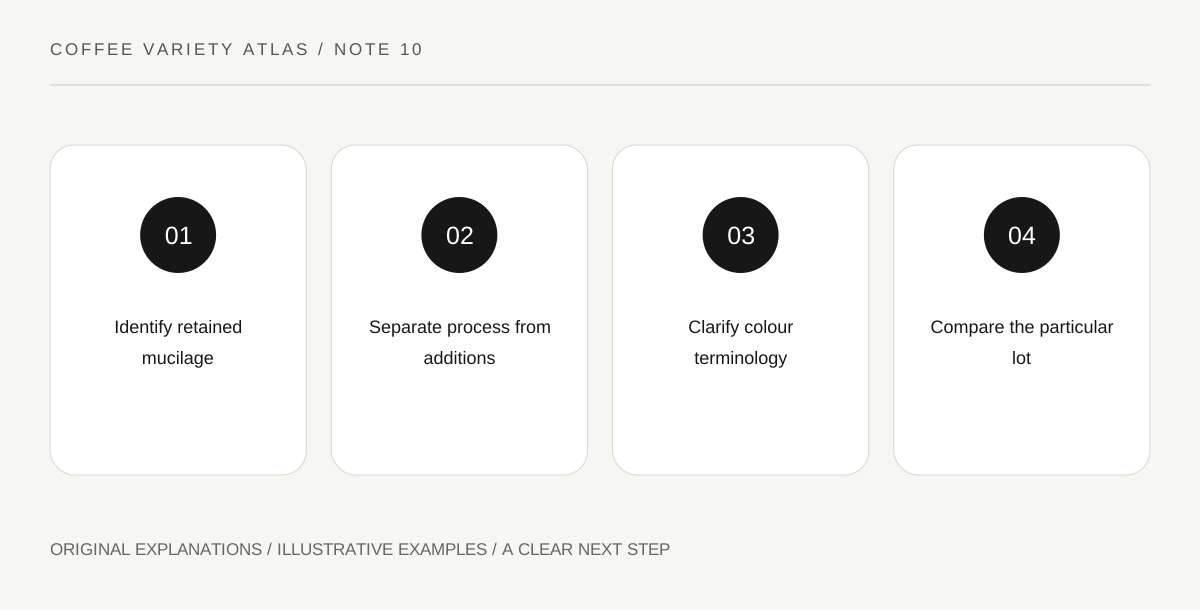
Original explanatory diagram. Read the full method and limitations below.
Locate the mucilage in the sequence
In a broad honey-process description, the outer pulp is removed while some mucilage remains around the seeds during drying. That places it differently from drying whole cherries or removing the mucilage more fully before drying. The name concerns fruit-layer handling before roasting.
Use a simplified three-way diagram for natural, washed and honey, showing which material remains at the drying stage. Label it as a broad explanation. Actual production sequences can be more complex, and this consumer guide is not an instruction for processing fruit safely or consistently.
Keep the name separate from ingredients
Honey in the process field does not by itself mean that honey has been added to the roasted coffee. A separate flavoured or co-processed product may have additions, so read the complete description and ingredients where provided. Do not infer either presence or absence of every addition from one word.
The same distinction applies to sensory sweetness. A process name does not establish sugar content in a prepared drink or a health property. A café can also add syrup or milk later, which belongs to the beverage’s ingredient information rather than the farm’s broad processing category.
Treat colour terms as producer-specific detail
You may encounter yellow, red or black honey descriptions. Do not assume those terms form one universally calibrated scale across every producer. Ask what the label means in that context, including which stages or drying choices the producer is describing.
Record the explanation with the lot instead of converting a colour word into an exact percentage you have not been given. The useful information is the actual process account. A neat colour chart can be memorable while still oversimplifying differences in practice.
Compare with careful sensory language
A honey coffee can be described in many ways, and a particular sweetness or body is not guaranteed by the label. Compare lots as whole products, noting origin, variety, processing detail and roast. Avoid claiming that one tasting proves a universal middle point between all natural and washed coffees.
For an exercise, read a fictional label saying red honey and write one question for the producer: What does red describe in your process? Then separate the answer from the roaster’s tasting notes. This preserves useful detail while resisting an attractive but unsupported rule about colour, flavour or added ingredients.
Illustrative honey-label reading
A fictional bag says yellow honey, Catuai, with caramel notes. The reader records Catuai as variety, yellow honey as the stated process description and caramel as a sensory note. They ask what yellow means for that producer rather than invent a mucilage percentage. No actual honey or caramel ingredient is assumed from those fields alone.
Practical checks
Optional checkboxes save only in this browser.
Questions that come up
Does honey-process coffee contain honey?
The process term alone does not indicate added honey. Read any separate ingredient or processing-addition information for the actual product instead of drawing the conclusion from the name.
Is black honey always sweeter than yellow honey?
Do not treat those terms as a universal flavour scale. Producer practices and lots vary. Ask what the colour means in that context and keep sensory expectations provisional.
References and scope
These sources support the factual background. Examples and exercises are original illustrative teaching material. References do not imply endorsement.
- National Coffee Association: Processes — Natural, washed and honey processing and the role of fruit layers.
- Specialty Coffee Association: The fermentation effect — Fermentation occurs in multiple processing systems; anaerobic conditions and process complexity.
- Specialty Coffee Association: Shifting coffee identity standards — Distinguishing processing descriptions, additions and the need for transparent identity information.
- World Coffee Research: Sensory lexicon — Sensory attributes and shared reference vocabulary; tasting language is not an ingredients list.