Read natural process as a whole-fruit drying description
Natural is a processing term in coffee, not a promise that other methods are unnatural. In a broad natural process, the fruit remains around the seeds during drying before later removal. Learn that sequence and separate it from organic certification, added flavours and assumptions about how every natural coffee should taste.
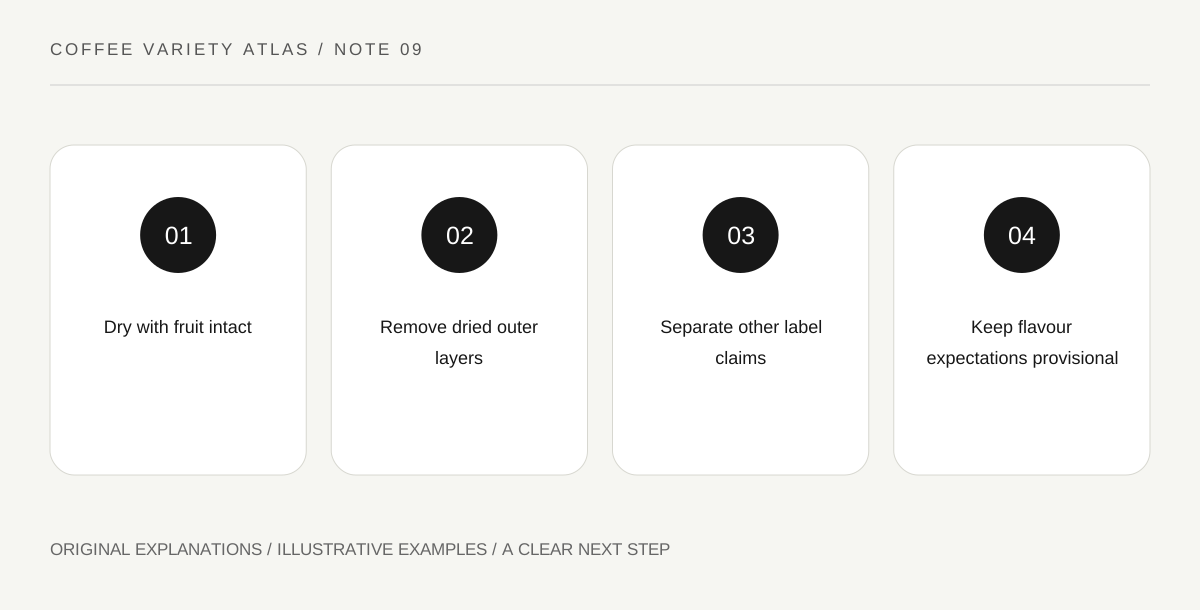
Original explanatory diagram. Read the full method and limitations below.
Follow the whole-fruit stage
The broad natural or dry method dries coffee with the cherry intact before the dried outer material is removed. This differs from removing much of the fruit before drying. The distinction concerns sequence and fruit layers, not whether the final roasted coffee contains whole fruit.
Draw two short timelines, one for natural and one for washed. Put the fruit-removal step at different points. The comparison makes the names easier to understand without turning the diagram into a farm recipe. Actual producers manage drying and other stages in more detailed ways than a consumer label can show.
Keep natural separate from organic
Natural process does not by itself establish how the crop was cultivated or whether it carries a certification. Organic is a separate claim with its own context. A label can contain both terms, one term or neither without those fields becoming synonyms.
Use a label-sorting exercise: place natural under process, a certification name under certification and a farm name under origin. If the package does not supply another claim, leave it unknown. The word natural should not silently acquire health, environmental or ingredient promises that the producer did not make.
Understand fruit association without a flavour guarantee
Natural coffees are often described with fruit-forward sensory language, but lots vary. The way fruit and seeds are handled, the plant material and later roasting all matter. A process name cannot guarantee that every drinker will perceive a particular berry or fermented note.
A sensory description resembling wine does not automatically establish an alcoholic ingredient, and a fruit note is not necessarily added fruit. Ask about ingredients or additions when relevant rather than infer them from a metaphor. Processing and sensory vocabulary need to be read together but kept distinct.
Ask what the producer actually reports
A broad natural label gives less detail than a producer’s account of a separated lot and its stages. More detail can help you compare coffees, but it should be read as information about that lot. Avoid turning one producer’s method into the definition of every natural coffee.
For an exercise, write two summaries of a fictional label: one containing only stated facts and one containing your expectations. Compare them and move any inferred quality or flavour promise into the expectation column. You can then taste with curiosity while knowing which parts came from the label and which from your own associations.
Illustrative category separation
A fictional bag says natural process, Arabica, chocolate and berry notes. A reader records process and species separately, then checks whether any ingredient or certification claim is actually present. Berry remains a sensory note, not proof that berries were added. The reader leaves organic status unknown rather than infer it from natural.
Practical checks
Optional checkboxes save only in this browser.
Questions that come up
Does natural process mean organic coffee?
No. They answer different questions. Natural describes processing, while organic is a separate cultivation and certification claim that must be evaluated on its own terms.
Must a natural coffee taste strongly fruity?
No. That is a possible association, not a guarantee. Lots differ, and sensory experience also depends on roasting, preparation and the individual drinker.
References and scope
These sources support the factual background. Examples and exercises are original illustrative teaching material. References do not imply endorsement.
- National Coffee Association: Processes — Natural, washed and honey processing and the role of fruit layers.
- Specialty Coffee Association: The fermentation effect — Fermentation occurs in multiple processing systems; anaerobic conditions and process complexity.
- Specialty Coffee Association: Shifting coffee identity standards — Distinguishing processing descriptions, additions and the need for transparent identity information.
- World Coffee Research: Sensory lexicon — Sensory attributes and shared reference vocabulary; tasting language is not an ingredients list.