Understand washed coffee by following what happens to the fruit layers
Washed describes a post-harvest process, not coffee that has been rinsed after roasting. Follow the fruit layers to understand the term, then read a producer’s more detailed account. The name can orient your expectations, but it does not guarantee one level of acidity, quality or cleanliness in every cup.
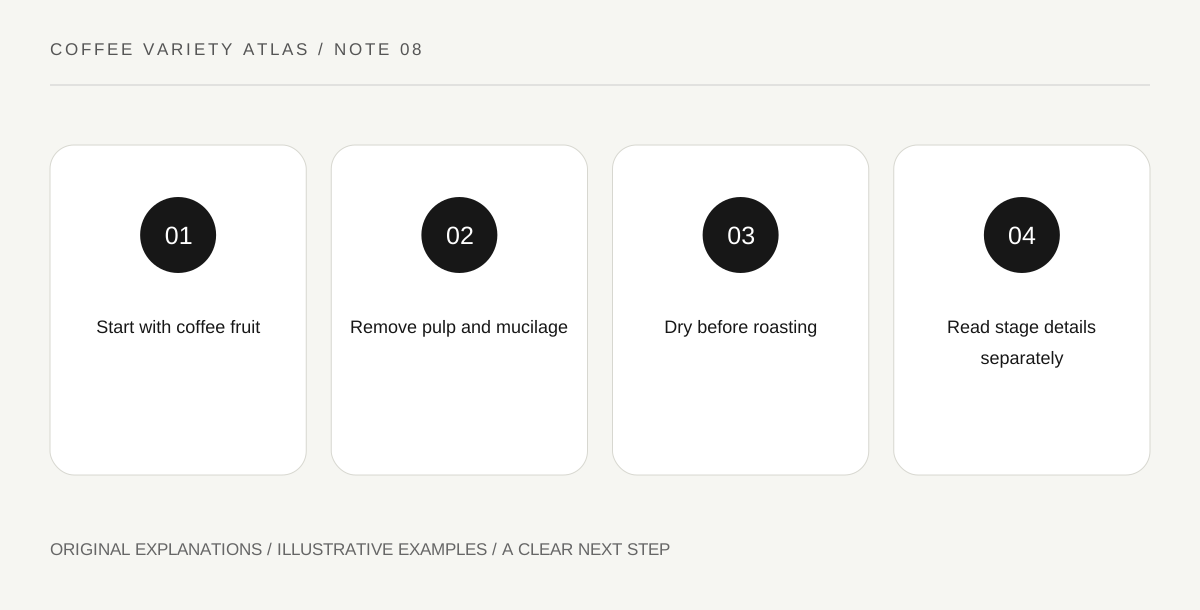
Original explanatory diagram. Read the full method and limitations below.
Begin with a fruit and its seeds
Coffee beans are seeds inside coffee cherries. Processing prepares those seeds for later storage and roasting by handling the surrounding fruit and drying the coffee. Keeping that sequence in mind prevents confusing a farm process with a café’s brewing or cleaning procedure.
Draw a simple cherry, seed and roasted-bean sequence. Put processing between harvest and roasting. A washed label belongs there, while espresso belongs to preparation later. The timeline is a useful way to sort terms without memorizing every producer’s equipment or exact method.
Identify the central washed-process distinction
In broad washed processing, pulp is removed and remaining mucilage is removed before the coffee is dried in its parchment stage. Actual systems can use different combinations of fermentation, washing and mechanical removal. The broad name does not specify every step or every time interval.
Read the producer’s description if it supplies more detail. Keep those details attached to that lot rather than assume they define all washed coffee. This article explains terminology and does not provide farm-processing instructions or a universal fermentation schedule.
Understand that fermentation is not absent
Washed does not mean no fermentation. Research summarized by the Specialty Coffee Association shows that microbial activity and seed processes can play roles within different processing systems. A simple washed-versus-fermented opposition therefore misrepresents the categories.
If a label adds a fermentation term, ask how it fits into the broader sequence. A washed coffee can have a specifically described fermentation stage. The two pieces of information can coexist rather than cancel each other. Distinguish the general process from a condition within it.
Keep sensory expectations flexible
Washed coffees are often discussed using terms such as clarity, but that language should not be treated as a guarantee or a statement about hygiene. Variety, origin, handling and roasting still influence the cup. A process name is useful context, not an exhaustive quality assessment.
For an exercise, compare two fictional washed labels, one with only the broad term and another with a detailed producer sequence. List what the extra information actually adds. Then write a cautious expectation rather than a prediction that every washed coffee must taste citrusy or sharp. The point is a better question, not a compulsory flavour note.
If the bag gives a broad process name only, record that limited description. You can ask for more detail, but leaving a blank is more accurate than filling the missing stage with a familiar explanation from another producer.
Illustrative process timeline
A fictional label reads washed, with a separately described fermentation stage. A reader places pulping and mucilage handling before drying, then roasting and brewing later. They do not assume the fermentation detail makes the coffee natural. Their summary says the lot uses a washed sequence with additional stage information, while the sensory outcome remains to be experienced.
Practical checks
Optional checkboxes save only in this browser.
Questions that come up
Does washed mean the brewed drink contains extra water?
No. It describes post-harvest handling of the coffee fruit and seeds. The final drink’s water and concentration depend on preparation, which is a different stage.
Is washed automatically cleaner or better?
No. Sensory clarity is not the same as hygiene, and the broad process name does not rank every lot. Evaluate actual production information and your experience without treating the label as a universal quality score.
References and scope
These sources support the factual background. Examples and exercises are original illustrative teaching material. References do not imply endorsement.
- National Coffee Association: Processes — Natural, washed and honey processing and the role of fruit layers.
- Specialty Coffee Association: The fermentation effect — Fermentation occurs in multiple processing systems; anaerobic conditions and process complexity.
- Specialty Coffee Association: Shifting coffee identity standards — Distinguishing processing descriptions, additions and the need for transparent identity information.