Tell Caturra and Catuai apart without treating them as spelling variants
Caturra and Catuai look similar on a label but identify different plant histories. Learn their documented relationship and practise reading the exact name. The goal is accurate recognition, not a prediction that one will always taste a particular way or be better than the other.
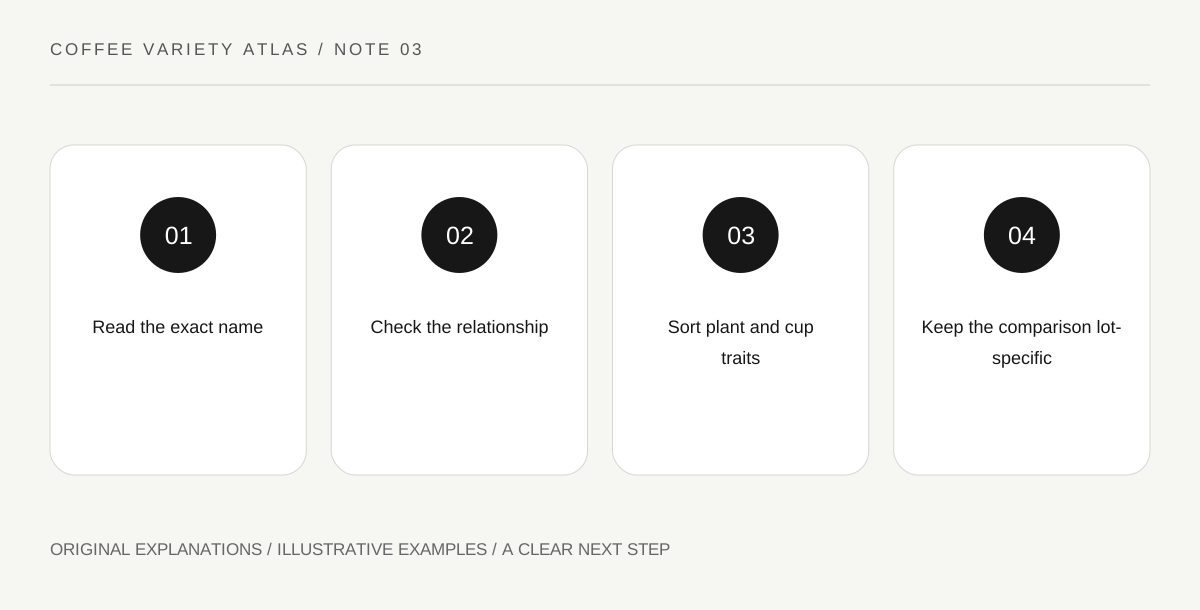
Original explanatory diagram. Read the full method and limitations below.
Keep the names distinct
World Coffee Research describes Caturra in relation to Bourbon and identifies Catuai as a cross involving Mundo Novo and Caturra. The relationship explains part of the similarity in a family diagram, but the names are not interchangeable. A misplaced letter can change the identity being claimed.
Write each name clearly on a separate card and add one short distinguishing fact from its catalog entry. Avoid a long list of agronomic traits that you do not need for reading a bag. The useful beginner distinction is that these are separate named varieties with a documented relationship.
Understand compact habit as a plant trait
A catalog may describe plant stature or compact growth. That information concerns the tree and cultivation, not the physical size of a café drink or a guarantee about the roasted bean’s flavour. Coffee terminology becomes clearer when you keep agricultural traits separate from sensory and menu categories.
Create a small chart with plant trait, lot information and cup observation as headings. Put compact habit under plant trait, washed under lot information and your own aroma description under cup observation. Sorting the categories prevents a real fact from being used to support a conclusion it does not establish.
Read breeding information without a purity hierarchy
A deliberate cross is part of coffee’s agricultural history. It is not automatically inferior to a named mutation or older variety. Farmers and breeders work with multiple priorities, including production and adaptation, while consumers encounter the result through a particular processed and roasted lot.
Do not turn historical age or parentage into a simple ranking. A catalog’s quality potential describes a context-dependent possibility, not a promise printed directly into every bean. The actual producer’s work and the lot’s handling remain relevant when you decide what you enjoy.
Use a family diagram for recognition
Draw Bourbon leading to Caturra, then place Caturra as one parent beside Mundo Novo leading to Catuai, using the catalog’s documented relationships. Label the diagram as simplified. It helps you remember the difference without pretending to include all variation or every selection within the names.
For an exercise, read three fictional labels, one Caturra, one Catuai and one mixed varieties. Record exactly what each says and avoid silently correcting an unfamiliar name to the familiar one. If a real label appears inconsistent, ask the supplier instead of inventing a confident identity from the taste.
Illustrative name correction
A reader writes Caturra in a notebook after seeing a fictional bag that actually says Catuai. They compare the label and correct the entry. The family diagram shows why the names are related but distinct. They keep the lot’s honey process and country in separate fields, then describe the cup without claiming those observations prove which variety was present.
Practical checks
Optional checkboxes save only in this browser.
Questions that come up
Are Caturra and Catuai the same coffee?
No. They are distinct named varieties with a documented relationship. Read the exact label and consult the relevant catalog entry rather than treating the names as alternative spellings.
Can taste alone identify which one is in a cup?
Not reliably from an ordinary tasting. Many production factors affect flavour, and a sensory impression is not a genetic identification. Use the lot’s traceability information for the identity claim.
References and scope
These sources support the factual background. Examples and exercises are original illustrative teaching material. References do not imply endorsement.
- World Coffee Research: Bourbon — Bourbon as an important Arabica variety and genetic family reference.
- World Coffee Research: Caturra — Caturra’s relation to Bourbon and compact plant habit.
- World Coffee Research: Catuai — Catuai’s Mundo Novo and Caturra parentage and breeding context.
- World Coffee Research: International variety-trial definitions — Landrace, genetic group, line, population and F1 hybrid definitions.