Read Typica and Bourbon as plant-family references rather than flavour guarantees
Typica and Bourbon are important names in Arabica coffee history and genetics. They can appear as named varieties or as references to broader related groups. Understand what a label is claiming, then keep that identity separate from country, cherry colour and the sensory description of a particular lot.
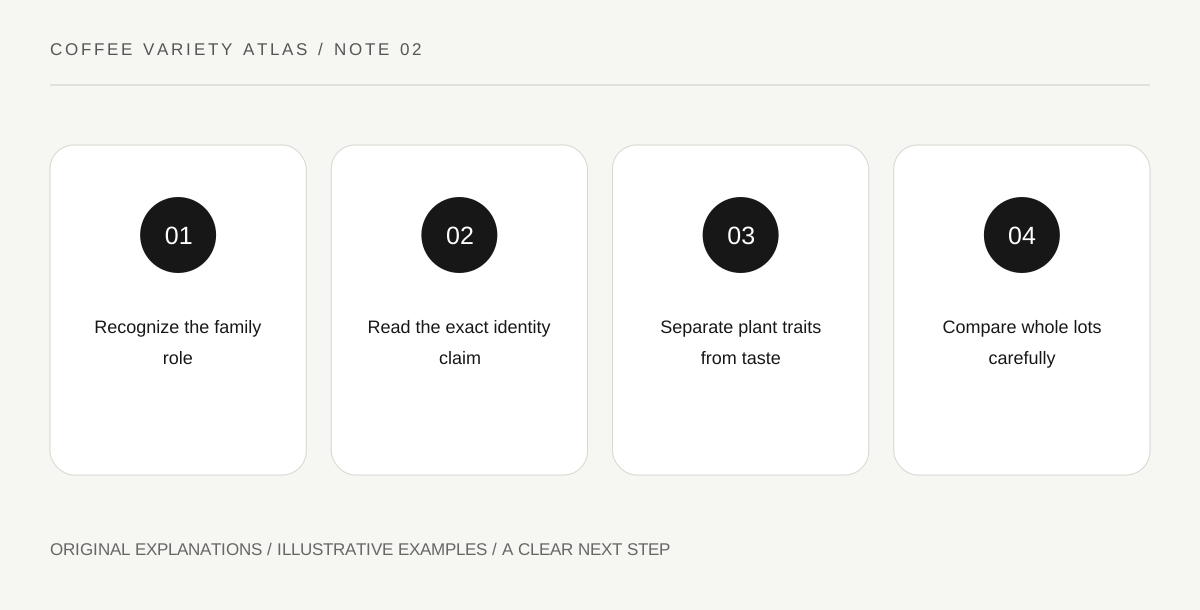
Original explanatory diagram. Read the full method and limitations below.
Recognize the historical and genetic role
World Coffee Research identifies Typica and Bourbon as culturally and genetically important Arabica coffees. Their related groups connect to many varieties encountered today. That importance explains why the names recur on labels and in variety catalogs; it does not mean every related coffee is identical.
Use a simple family sketch to show that a named descendant can have a relationship without being the same variety as its ancestor. Avoid turning the sketch into a complete genealogy from memory. When parentage matters, consult the particular catalog entry rather than assume a similar-sounding name proves a relationship.
Distinguish a variety name from a group description
A label may say Bourbon, Bourbon-related or mixed varieties. Those descriptions provide different levels of specificity. Ask whether the lot is represented as one named variety or a broader collection of plant material. The wording matters more than the visual prominence of the name on the package.
Keep the claim proportionate to its evidence. A producer’s identification can be useful information without being presented as a laboratory result. This distinction is especially important when a name is used loosely across regions or when a lot combines deliveries from several farms.
Do not convert cherry colour into a tasting rule
Coffee descriptions may add a colour word to a variety name. The colour of ripe fruit does not automatically tell you that the brewed coffee will taste like a fruit of that colour. Sensory notes describe the lot as evaluated, while plant traits and fruit appearance belong to another category.
Read the complete lot description rather than infer sweetness, acidity or quality from a single colour word. A coffee can be interesting for its plant identity and still differ from another lot with the same name because of growing conditions, processing and roast.
Make a comparison that preserves the unknowns
If you encounter two lots labelled Typica and Bourbon, note the other differences before attributing every sensory contrast to variety. Different farms, processing methods and roast approaches make the comparison a comparison of whole lots. It can still be enjoyable and informative.
For an exercise, create a two-column identity card for each fictional lot: what is stated and what is not established. Then write a cautious sentence such as These lots differ in several ways, including variety. That is more accurate than announcing that one tasting has revealed the universal flavour of an entire family.
Illustrative family-name comparison
A reader compares a fictional washed Typica from one farm with a natural Bourbon from another. They notice different aromas but record both process and origin differences. Their conclusion is that the two lots offered different experiences, not that natural-fruit notes are an inevitable property of Bourbon. The family names remain useful context without carrying every explanation.
Practical checks
Optional checkboxes save only in this browser.
Questions that come up
Does Bourbon coffee contain bourbon whiskey?
The plant variety name does not by itself indicate an alcoholic ingredient or flavour addition. Check the actual ingredients and processing description if a product makes a separate barrel or flavour claim.
Can one tasting define Typica or Bourbon for me?
It can establish your experience of that lot. It cannot isolate every cause or guarantee how all other coffees with the name will taste. Keep the comparison specific.
References and scope
These sources support the factual background. Examples and exercises are original illustrative teaching material. References do not imply endorsement.
- World Coffee Research: Typica — Typica’s identity and lineage context, distinct from a country or preparation method.
- World Coffee Research: Bourbon — Bourbon as an important Arabica variety and genetic family reference.
- World Coffee Research: International variety-trial definitions — Landrace, genetic group, line, population and F1 hybrid definitions.
- World Coffee Research: Sensory lexicon — Sensory attributes and shared reference vocabulary; tasting language is not an ingredients list.