Separate coffee species, variety and origin on a bag label
A coffee bag can name a species, a plant variety and a place without those terms competing. They answer different questions. Learn to sort the information before using any one word as a promise of quality or flavour, and notice when a label gives only a broad level of identity.
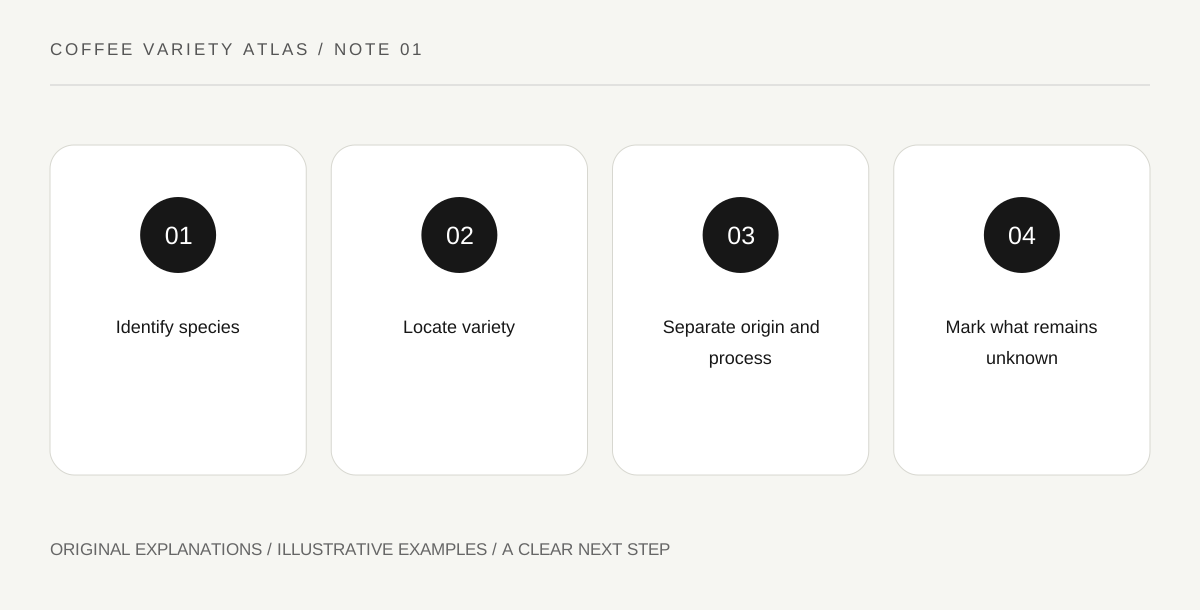
Original explanatory diagram. Read the full method and limitations below.
Start with the species level
Coffea arabica and Coffea canephora are different species commonly encountered in commercial coffee; robusta is associated with canephora. Species names are broader than named varieties such as Bourbon or Caturra. A bag saying Arabica has not supplied the same level of detail as a documented variety name.
World Coffee Research’s robusta catalog shows that robusta itself contains diversity. Avoid treating it as one uniform product or using the species word as a complete quality judgment. The actual lot, production and preparation still matter, and a label cannot tell you everything about the cup.
Place variety beneath that broader identity
A named Arabica variety describes plant material, not the country where it must be grown. The same variety can appear in more than one origin. Conversely, a country can grow several varieties. These relationships make a simple species–variety–place chart more useful than a list of supposedly interchangeable coffee types.
Write three columns on paper. Put Arabica in the species column, Bourbon in the variety column and a stated country or farm in the origin column. If one field is missing, leave it blank rather than infer it from a tasting note or a familiar regional association.
Keep processing and roasting in other fields
Washed describes post-harvest processing; medium roast describes a roaster’s treatment or category. Neither is a plant variety. Espresso may describe an intended preparation or blend identity. A bag can therefore carry all these terms coherently when each is understood at its own level.
Try sorting every prominent word from a sample label into plant, place, process, roast or sensory description. A word that does not fit may be a brand name or marketing phrase. The exercise helps you identify what information is actually present without demanding that every package use the same layout.
Use identity to ask better questions
A more detailed label gives you additional questions, not certainty about preference. Ask whether a lot contains one stated variety or a mixture and what the origin name refers to. Keep the producer’s description separate from an independent genetic verification unless such evidence is actually provided.
For a learning exercise, compare two fictional labels with different amounts of detail. Explain what each establishes and what remains unknown. You can prefer either coffee after tasting; the purpose is accurate interpretation rather than rewarding the longest label or treating missing data as proof of poor quality.
Illustrative label sorting
A fictional bag reads Arabica, Caturra, Costa Rica, honey process, medium roast, cocoa and citrus notes. A reader places each term in its own field. Cocoa is a sensory description, honey is a processing name and Caturra is the plant variety. None alone establishes added ingredients, a brewing recipe or a guaranteed flavour experience.
Practical checks
Optional checkboxes save only in this browser.
Questions that come up
Does 100% Arabica identify the exact variety?
No. It identifies a broader species claim, while Arabica contains many named varieties and populations. Look for additional lot information if variety matters to your comparison.
Can the same variety grow in different countries?
Yes. Variety and geographical origin answer different questions. Growing conditions, processing and roasting can also differ, so a shared variety does not guarantee an identical cup.
References and scope
These sources support the factual background. Examples and exercises are original illustrative teaching material. References do not imply endorsement.
- World Coffee Research: Typica — Typica’s identity and lineage context, distinct from a country or preparation method.
- World Coffee Research: Bourbon — Bourbon as an important Arabica variety and genetic family reference.
- World Coffee Research: Robusta catalog — Robusta’s genetic and variety diversity; distinction between species and named varieties.
- World Coffee Research: International variety-trial definitions — Landrace, genetic group, line, population and F1 hybrid definitions.
- National Coffee Association: Varieties — Origin and multiple production factors affect coffee descriptions; single origin can refer to different geographical scales.