Ask what a Gesha or Geisha label actually identifies
Gesha and Geisha are familiar coffee names, but spelling and reputation do not establish a lot’s exact plant material or origin. Use the documented variety context to ask focused questions. Keep a name, a farm’s traceability and the experience of one cup separate from assumptions about rarity or guaranteed quality.
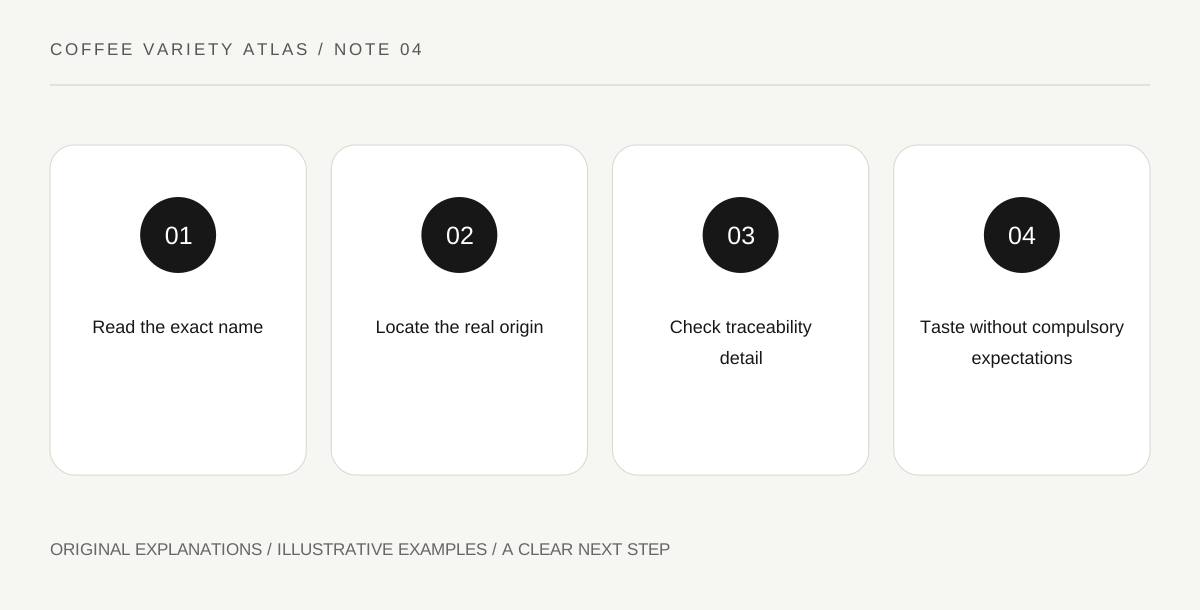
Original explanatory diagram. Read the full method and limitations below.
Recognize the naming complexity
World Coffee Research’s Geisha, Panama entry identifies an Ethiopian landrace background and discusses the name in a specific plant-history context. The entry is useful precisely because a familiar word can be used across material with different histories. Do not assume spelling alone proves identical genetics.
Copy the supplier’s exact wording, then ask which variety or selection is meant if the detail matters. A name can be informative without answering every traceability question. Avoid silently expanding a short label into a complete story about collection, introduction or farm history that the producer has not provided.
Keep the variety separate from the growing place
A coffee bearing the name can be grown outside Panama. The variety reference and the origin field are distinct. Likewise, a Panamanian coffee is not automatically Gesha merely because that country is associated with celebrated lots. Read both fields rather than let reputation fill an empty one.
A farm, region and country are also different scales of origin. Ask what the stated place identifies and whether the lot is separated as described. This is a practical traceability question, not a demand that every consumer obtain genetic testing before enjoying a cup.
Treat flavour potential as potential
A variety can have recognized sensory potential under suitable conditions without guaranteeing a particular floral note in every serving. Processing, roast and preparation still shape the experience. A famous name does not require you to report a flavour you do not perceive.
Use your own plain-language observation before reading an elaborate tasting description if you want to reduce suggestion. You can then compare the terms without turning disagreement into failure. The bag’s note is an interpretation of the lot, not a checklist you must complete to prove that the coffee deserves its reputation.
Evaluate the information rather than the prestige
Read producer, lot, process and roast information together. A high-status name or a story about auction records is not a substitute for explaining the coffee in front of you. This article does not recommend purchases or reproduce current prices; it teaches identity interpretation.
For an exercise, compare a fictional label saying only Geisha with one giving a producer, origin and more precise variety description. State what additional questions each leaves open. The more detailed label is more informative, but neither guarantees your preference. Keep curiosity independent from pressure to admire a famous name.
Illustrative reputation check
A fictional bag says Gesha, grown in Colombia, washed process. A reader correctly records Colombia as origin and Gesha as the stated plant identity. They do not change the origin to Panama or assume a particular auction history. After tasting, they describe what they notice and leave an expected floral note unconfirmed rather than copy it into their own experience.
Practical checks
Optional checkboxes save only in this browser.
Questions that come up
Does the name always mean the coffee was grown in Panama?
No. A plant identity can be grown in more than one place. Read the lot’s actual origin field rather than infer it from the name’s reputation.
Is one spelling proof of authenticity?
No. Spelling alone does not establish plant material, provenance or quality. Consult the producer’s description and the relevant documented variety context when precise identity matters.
References and scope
These sources support the factual background. Examples and exercises are original illustrative teaching material. References do not imply endorsement.
- World Coffee Research: Geisha, Panama — Gesha/Geisha naming, Ethiopian landrace background and limits of assuming identical material from a name.
- World Coffee Research: International variety-trial definitions — Landrace, genetic group, line, population and F1 hybrid definitions.
- World Coffee Research: Sensory lexicon — Sensory attributes and shared reference vocabulary; tasting language is not an ingredients list.
- National Coffee Association: Varieties — Origin and multiple production factors affect coffee descriptions; single origin can refer to different geographical scales.