Read decaf as a processing choice, not a plant variety or zero-caffeine promise
Decaf tells you that caffeine has been reduced through a process; it does not identify the coffee’s species, variety or origin. Learn to read the remaining label fields and distinguish a processor’s named method from a universal claim about every decaffeinated coffee. The cup still has a production history beyond caffeine removal.
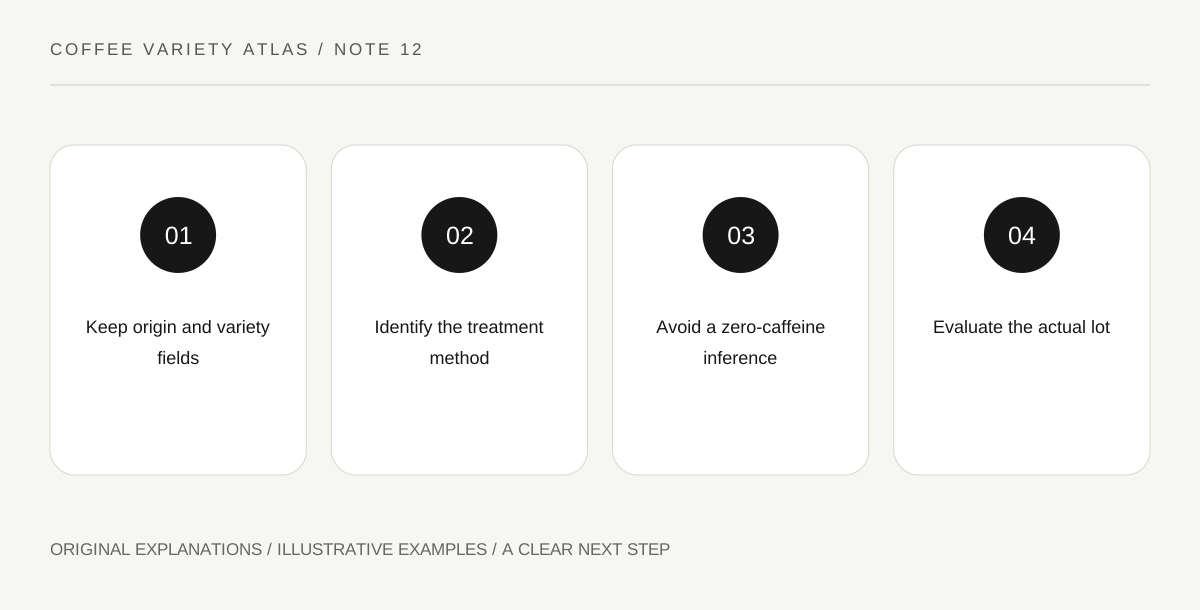
Original explanatory diagram. Read the full method and limitations below.
Keep the plant identity intact
A decaffeinated coffee can still be described by origin, variety, original processing and roast. Those fields do not disappear because decaf is prominent on the front. Put decaffeination in its own part of the timeline rather than treat it as a species alongside Arabica.
Use a fictional label to identify what is stated: a named origin, a blend or single lot, a roast description and the decaffeination method if supplied. Missing detail can remain unknown. You do not need to assume that every decaf starts from the same generic green coffee.
Distinguish method names from broad impressions
Water-based, carbon-dioxide and solvent-based descriptions refer to different approaches, while a branded process identifies a particular operator’s system. Read that operator’s explanation when you want detail. Swiss Water, for example, describes its own water-based system; its page is not a definition of every decaf method.
Avoid using words such as chemical-free as a complete scientific explanation. Ask what process is actually described and what claim the producer supports. This article does not compare medical safety or make regulatory conclusions about methods; those questions require authoritative information suited to the claim.
Do not assume caffeine is entirely absent
Decaffeination reduces caffeine rather than necessarily removing every trace. A decaf label alone does not give an exact amount for your particular serving. Bean composition, preparation and serving size can also affect the amount in the cup.
If caffeine avoidance is important for an individual reason, use the actual product information and appropriate professional guidance instead of a generic coffee article. This is a label-reading boundary, not a recommendation about how much caffeine anyone should consume or a claim that one method solves a health concern.
Read flavour information without the apology
A decaf can have its own sensory description and roast intention. You do not need to evaluate it only as a lesser substitute for another bag. At the same time, a process brand does not guarantee that you will prefer the result. The actual lot remains the relevant object of experience.
For an exercise, compare a fictional decaf label with a caffeinated label and list which fields are common. Then note which extra question decaffeination introduces. This keeps the category informative without erasing origin or turning the method into a promise of identical taste, complete caffeine absence or universal suitability.
Illustrative decaf label map
A fictional bag says Colombian coffee, medium roast, water-process decaf. The reader records Colombia as origin, medium as roast and water-process decaf as a separate treatment description. The plant variety is not supplied. They do not infer zero caffeine or a particular health effect, and they read the tasting notes as a description of this lot.
Practical checks
Optional checkboxes save only in this browser.
Questions that come up
Does decaf mean a naturally caffeine-free plant?
Not in the ordinary decaffeinated-coffee category. It describes caffeine reduction through processing. Any claim about a particular low-caffeine plant variety would be a separate identity claim.
Can the process name tell me the exact caffeine in my cup?
No. It does not by itself provide a serving-specific amount. Check product and preparation information when that detail matters, and use appropriate guidance for individual health concerns.
References and scope
These sources support the factual background. Examples and exercises are original illustrative teaching material. References do not imply endorsement.
- National Coffee Association: Decaf coffee — Decaffeination as a process rather than a plant variety; caffeine is reduced rather than necessarily absent.
- Swiss Water: Decaffeination process — A primary processor’s explanation of its water-based decaffeination system; not a claim about all decaf.
- World Coffee Research: Sensory lexicon — Sensory attributes and shared reference vocabulary; tasting language is not an ingredients list.
- National Coffee Association: Varieties — Origin and multiple production factors affect coffee descriptions; single origin can refer to different geographical scales.