Read coffee tasting notes without turning them into an ingredients list
Chocolate, citrus or floral words on a coffee bag may describe sensory resemblance rather than added ingredients. Learn to distinguish a tasting vocabulary from composition and from your own experience. A useful note can be broad, tentative and personal without pretending you identified every descriptor printed on the package.
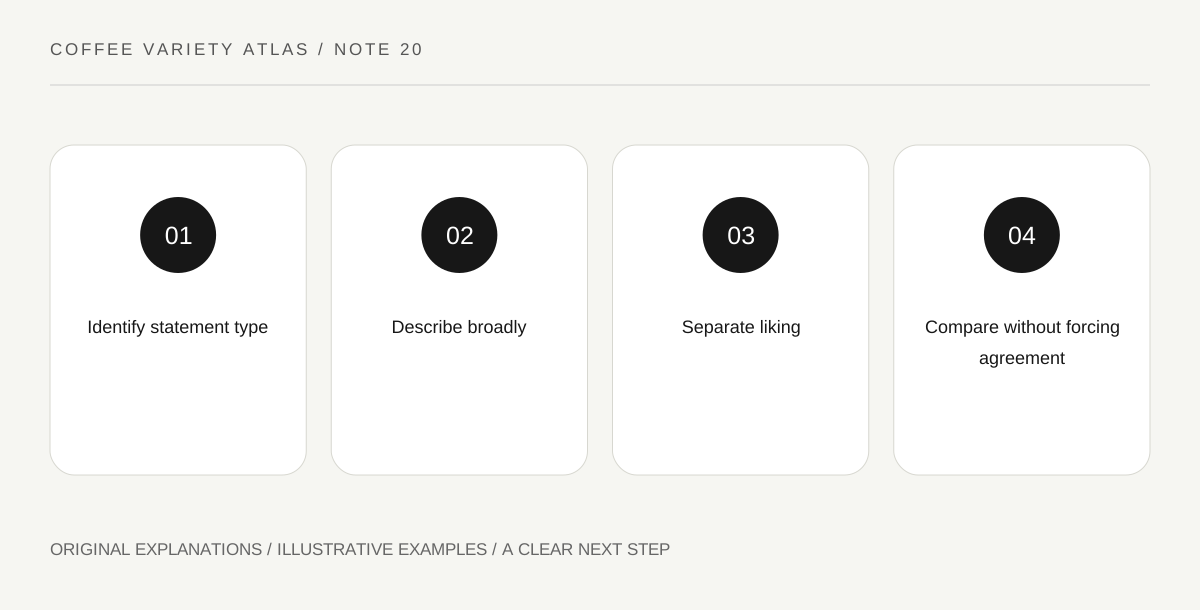
Original explanatory diagram. Read the full method and limitations below.
Identify what kind of statement you are reading
A tasting note describes an evaluator’s sensory impression of a coffee. An ingredient statement describes what is in a product. A processing description may provide another kind of information about additions or handling. These fields can interact, but one should not silently replace another.
Read the wording around the descriptor. Notes of cocoa is different from a product explicitly described as flavoured with cocoa. If the distinction is unclear and matters to your decision, ask the supplier. Do not assume either addition or absence solely from an evocative front-label phrase.
Use broad sensory language first
World Coffee Research’s sensory lexicon provides a shared framework for describing attributes with reference vocabulary. A beginner does not need to reproduce a professional assessment. Start with a broad observation such as fruit-like, nutty or floral, then become more specific only when the comparison is meaningful to you.
Avoid selecting a precise fruit because the label suggests that you should. You can say the cup reminds you of something sweet and toasted without confidently naming caramel. A modest accurate description is more useful than a detailed borrowed one that does not reflect your experience.
Separate description from liking
A flavour can be clearly perceived and still not be your preference. Conversely, you can enjoy a cup without finding an elaborate vocabulary for it. Sensory description and personal liking are different judgments. A prestigious descriptor does not obligate admiration.
Write one line about what you notice and another about whether you enjoy it. Keep any uncertainty visible. This helps prevent a negative preference from becoming a claim that the coffee is objectively defective, or a positive preference from becoming proof that the label’s entire story is correct.
Compare the note with the whole lot identity
Origin, variety, process and roast can inform expectations, but the tasting descriptor does not independently verify those fields. A berry impression is not a genetic test or proof of a particular process. Use traceability information for identity and your senses for the experience.
For an exercise, describe a familiar cup before reading the package notes, then compare the two accounts. Look for overlapping broad ideas without forcing an exact match. The goal is a more attentive vocabulary, not a performance in which every reader must discover identical flavours or claim professional cupping expertise.
In a notebook, separate “label says” from “I notice.” This small distinction preserves the producer’s description without pressuring you to reproduce it. Different perceptions can be recorded clearly without turning either observation into a universal flavour claim.
Illustrative sensory note
A fictional bag lists cocoa, orange and flowers. A reader first writes toasted aroma, bright impression and a finish they enjoy. After reading the label, they find cocoa a useful comparison but do not perceive flowers clearly. They keep that uncertainty and check ingredients separately. Their note remains an honest account rather than a copied checklist.
Practical checks
Optional checkboxes save only in this browser.
Questions that come up
Does a chocolate note mean chocolate was added?
Not necessarily. It may describe resemblance. Read the ingredient and processing information for the actual product, and ask when wording is ambiguous.
Am I wrong if I cannot taste the listed notes?
Not automatically. Experience, context and individual perception differ. Use the label as a comparison prompt while keeping your own observations honest and avoiding forced precision.
References and scope
These sources support the factual background. Examples and exercises are original illustrative teaching material. References do not imply endorsement.
- Specialty Coffee Association: The fermentation effect — Fermentation occurs in multiple processing systems; anaerobic conditions and process complexity.
- Specialty Coffee Association: Shifting coffee identity standards — Distinguishing processing descriptions, additions and the need for transparent identity information.
- World Coffee Research: Sensory lexicon — Sensory attributes and shared reference vocabulary; tasting language is not an ingredients list.