Compare single origin and blend by the scale of the claim
Single origin and blend are useful descriptions, but they do not form a simple quality ranking. An origin can be a country, region or farm, while a blend can be deliberately composed for a particular result. Read the scale and purpose before deciding what either term tells you about the coffee.
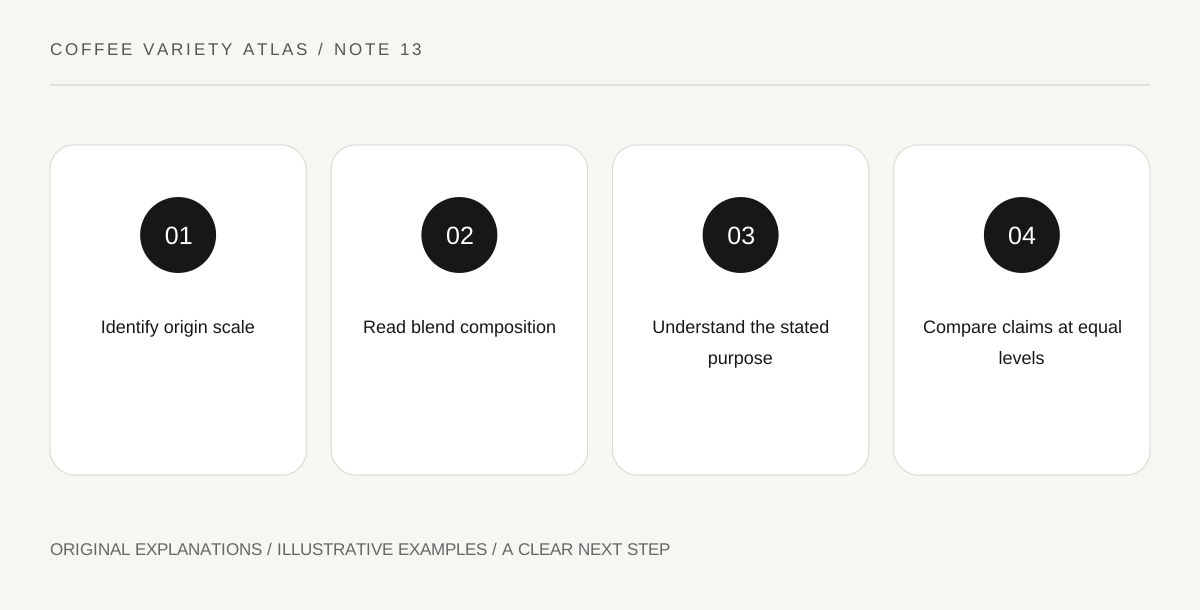
Original explanatory diagram. Read the full method and limitations below.
Ask what one origin means here
A country-level origin contains more diversity than a separated farm lot. Both may appear under single-origin language depending on the seller’s usage. The phrase alone does not establish the smallest possible traceable unit. Look for the named place and how the producer or roaster describes it.
Record the scale explicitly: country, region, cooperative, farm or a more specific lot when given. Do not infer a single plot from a country name. A clear broad claim is still useful; it simply answers a broader question than a detailed lot description.
Understand what a blend combines
A blend may combine coffees from different origins or lots to achieve a desired sensory or preparation profile. Its components and proportions may change or remain undisclosed. Ask what the roaster chooses to explain rather than assume blend means an accidental mixture.
A blend can still provide origin information, and a single-origin coffee can still contain multiple varieties or farms within the stated scale. These categories do not line up as one-versus-many in every possible sense. Identify which dimension the label is talking about before drawing a conclusion.
Separate purpose from prestige
A roaster might design a blend for a consistent milk drink or present a separated lot to highlight a particular production story. Those are different aims, not automatic evidence that one is inferior. You can value transparency while also appreciating a deliberately composed product.
Read sensory descriptions and intended use without treating them as compulsory preferences. A single-origin coffee may not suit the experience you want, while a blend may. The choice can be about the actual result rather than a status hierarchy attached to a term.
Compare information at equal levels
When comparing labels, ask whether both provide the same scale of detail. A named farm and a country blend cannot be evaluated for traceability by counting the number of place words alone. Look at what each claim actually identifies and what remains unspecified.
For an exercise, make cards for a fictional country-level coffee, a separated farm lot and a multi-origin blend. List one useful question for each. The exercise is successful when you can describe their differences without turning the broadest label into a false promise or the blend into a quality accusation.
Also record whether the stated origin refers to every component or to a named component within a blend. Those sentences can sound similar while describing different products; reading their qualifiers prevents a misleading comparison.
Illustrative origin comparison
A fictional bag says single origin, Peru, while another says blend of coffees from Peru and Brazil. The first does not name a farm; the second explains its multi-country composition. A reader records those facts and does not assume the first contains one variety or the second equal percentages. Both can be tasted without a preassigned winner.
Practical checks
Optional checkboxes save only in this browser.
Questions that come up
Does single origin mean one farm?
Not necessarily. It can refer to different geographical scales. Read the actual origin description and ask for clarification if farm-level traceability matters to you.
Are blends lower quality?
The term alone does not establish that. Blends can be intentionally composed, and single-origin coffees vary. Evaluate the actual information and experience rather than rank the categories automatically.
References and scope
These sources support the factual background. Examples and exercises are original illustrative teaching material. References do not imply endorsement.
- Specialty Coffee Association: Shifting coffee identity standards — Distinguishing processing descriptions, additions and the need for transparent identity information.
- World Coffee Research: Sensory lexicon — Sensory attributes and shared reference vocabulary; tasting language is not an ingredients list.
- National Coffee Association: Varieties — Origin and multiple production factors affect coffee descriptions; single origin can refer to different geographical scales.