Separate roast names from plant variety and growing origin
A roast description tells you about a transformation after the coffee was grown and processed. It does not identify the plant or prove where the coffee came from. Learn to distinguish broad roast categories, branded names and intended preparation, then use them as context rather than a universal flavour or caffeine scale.
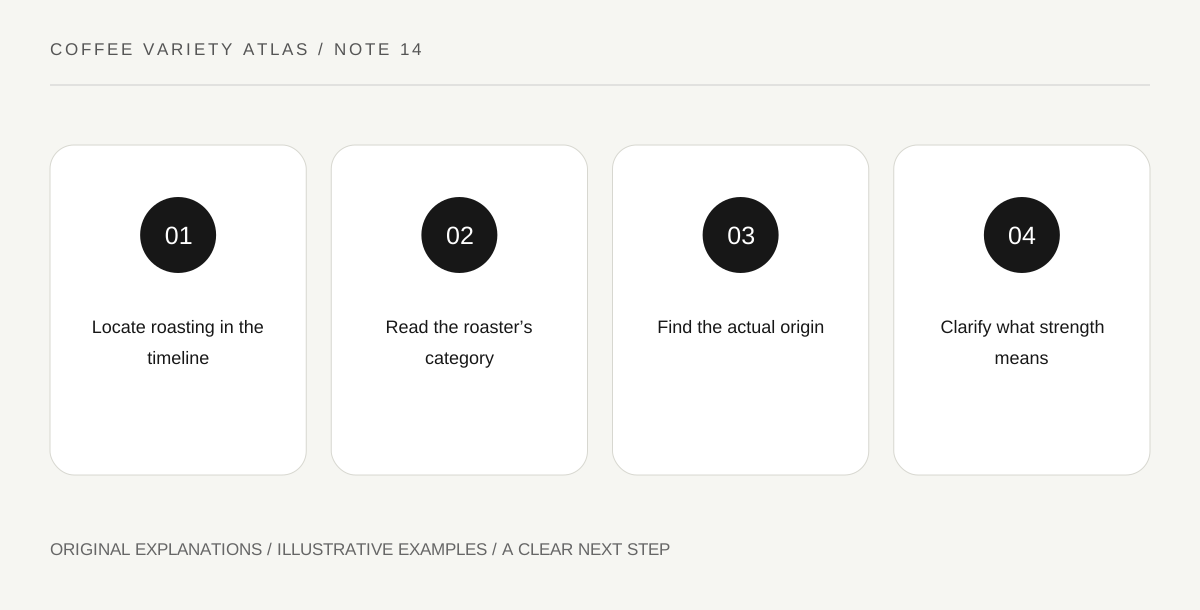
Original explanatory diagram. Read the full method and limitations below.
Place roasting after green-coffee production
Roasting uses heat to transform green coffee into the aromatic brown material used for brewing. A variety name such as Caturra belongs to plant identity, while washed belongs to earlier processing. Keeping the sequence clear prevents one prominent label word from swallowing the rest of the coffee’s history.
Draw the timeline and place a roast date beside roasting, not harvest. A date field may need clarification if the label uses several dates. Read what each date actually means rather than assume every printed day is the day the coffee was roasted.
Treat light, medium and dark as broad language
These categories can help communicate a roaster’s intention, but they are not a single universally calibrated consumer scale across every brand. Two bags called medium may differ. Read the producer’s own description and compare actual appearance and sensory information without expecting exact equivalence.
Do not use surface oil alone as a complete quality judgment. Appearance can prompt a question, but the category, handling and intended profile need context. This article does not provide a home-roasting procedure or a rule that one visible feature diagnoses every problem.
Keep geographical roast names separate from origin
A name such as French or Italian roast may be used as a roast-style term rather than a statement that the beans were grown in that country. Look for the actual origin field. A familiar place word can perform more than one job on a label.
Likewise, espresso roast often describes a product intended for a preparation rather than a distinct coffee species. The label can be useful without creating an exclusive rule that the beans can only be used one way. Ask what the roaster means if the intended profile is unclear.
Avoid a one-dimensional strength scale
Darkness, perceived roast flavour, drink concentration and caffeine are different concepts. A darker-sounding name does not by itself tell you the exact caffeine in a serving or how concentrated a café drink will be. Preparation and serving details belong to those questions.
For an exercise, sort a fictional label into origin, variety, process, roast category and intended use. Then write one sentence about what remains unknown. This creates a clear interpretation without turning light into automatically sour, dark into automatically stronger or a branded intensity number into a universal measurement.
Illustrative roast-word sorting
A fictional bag reads Italian-style espresso roast, beans from Brazil and Colombia. The reader records the two countries as origin information and Italian-style as a roast description. Espresso is an intended preparation reference. They do not infer that the coffee was grown in Italy or that a serving contains more caffeine than every lighter roast.
Practical checks
Optional checkboxes save only in this browser.
Questions that come up
Does espresso roast name a coffee plant?
No. It generally describes a product or roast intention associated with espresso preparation. Species and variety information belong in separate label fields.
Is dark roast always stronger?
Stronger can mean several things. Roast character, concentration and caffeine are not identical. Ask which property is meant and use the actual product and serving information rather than the roast word alone.
References and scope
These sources support the factual background. Examples and exercises are original illustrative teaching material. References do not imply endorsement.
- World Coffee Research: Typica — Typica’s identity and lineage context, distinct from a country or preparation method.
- World Coffee Research: Caturra — Caturra’s relation to Bourbon and compact plant habit.
- National Coffee Association: Roasts — Roasting as transformation of green coffee and broad roast terminology.
- Starbucks: Espresso explained — A café operator’s examples of espresso, Americano and espresso-and-milk drink construction; recipes are operator-specific.