Understand F1 hybrid coffee without a pure-versus-artificial shortcut
A hybrid name describes plant parentage and generation, not a verdict on whether a coffee is natural, authentic or enjoyable. Learn the basic F1 meaning through a documented example. Then distinguish agricultural aims from sensory claims about a particular processed and roasted lot.
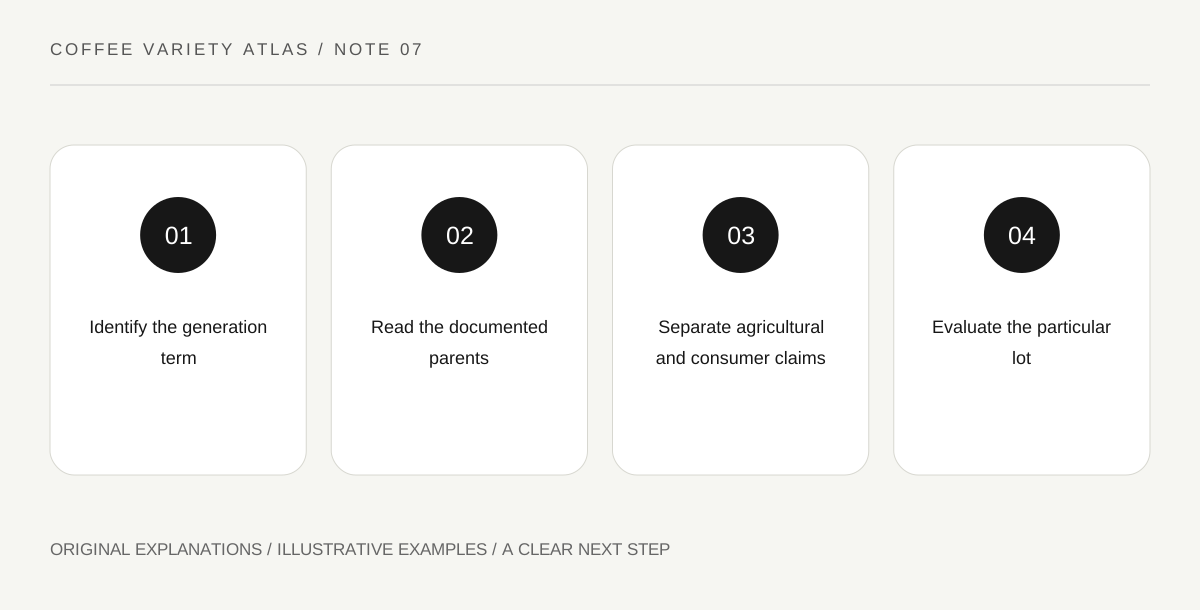
Original explanatory diagram. Read the full method and limitations below.
Read F1 as a generation term
World Coffee Research defines an F1 hybrid as first-generation offspring from parents of different genetic origins. Its Centroamericano entry provides a specific example with documented parentage. The term is more precise than a general marketing impression of modern or traditional coffee.
Draw two parent boxes leading to one F1 box and label the diagram as simplified. Do not infer that every plant in a commercial bag can be identified from that sketch. The purpose is to understand the term, not reproduce a breeding program or establish a lot’s genetics independently.
Recognize multiple breeding priorities
Farmers and breeders may consider production, adaptation, disease pressures and quality potential together. A consumer sees only a small part of that agricultural decision through the final cup. Avoid assuming that a variety selected for practical farming reasons cannot also produce a coffee someone enjoys.
Likewise, a promising catalog description is not a guarantee of a particular result on every farm. Conditions and plant material matter. This article is for label literacy, not planting advice, and current agricultural recommendations require the appropriate local expertise and evidence.
Avoid a false purity ranking
Older varieties, mutations, landraces and deliberate crosses have different histories. Those categories do not create a simple scale from authentic to artificial. A name’s age does not by itself establish flavour quality, and a breeding term does not make the drink a synthetic product.
Keep any separate claims about genetic engineering, organic certification or added flavour in their own categories. Hybrid alone does not answer all those questions. Ask what a claim specifically means and what evidence supports it rather than let one unfamiliar scientific word carry several unrelated conclusions.
Evaluate the lot you actually encounter
Read origin, process, roast and sensory description alongside the variety identity. If you compare a hybrid lot with another coffee, note all the other differences before claiming parentage caused the result. A tasting can establish preference without isolating a genetic effect.
For an exercise, summarize a fictional Centroamericano label in plain English: a stated F1 variety, a named origin and a separate processing description. Add what remains unknown. This turns technical language into an accurate explanation while preserving the grower’s context and the limits of a consumer label.
A useful reading exercise is to underline the breeding statement, circle the commercial lot name, and box the sensory description. These are three different claims. A document supporting parentage does not independently verify what happened to one harvested lot.
Illustrative hybrid interpretation
A reader sees Centroamericano, F1 hybrid, washed on a fictional bag. They consult the catalog and record that F1 describes a first-generation cross. They do not infer artificial flavouring or a health property. After tasting, they note their own preference and keep the processing and roast separate from the plant’s breeding history.
Practical checks
Optional checkboxes save only in this browser.
Questions that come up
Does hybrid mean genetically engineered?
The F1 term describes a first-generation cross and does not by itself establish a genetic-engineering claim. Read any separate claim precisely instead of treating these categories as interchangeable.
Are older varieties always better in the cup?
No universal ranking follows from age. The particular lot, growing conditions, processing and roasting matter, and personal preference remains an observation rather than a verdict on the entire breeding category.
References and scope
These sources support the factual background. Examples and exercises are original illustrative teaching material. References do not imply endorsement.
- World Coffee Research: Centroamericano — An F1 hybrid example with documented parentage and breeding context.
- World Coffee Research: International variety-trial definitions — Landrace, genetic group, line, population and F1 hybrid definitions.
- World Coffee Research: Sensory lexicon — Sensory attributes and shared reference vocabulary; tasting language is not an ingredients list.