Read landrace and heirloom as different levels of information
A broad plant-population description does not give the same precision as a named selection. Terms such as landrace or heirloom may appear when a coffee’s identity is described generally. Learn what a documented landrace definition establishes and ask what the supplier means instead of inventing a single variety behind a broad label.
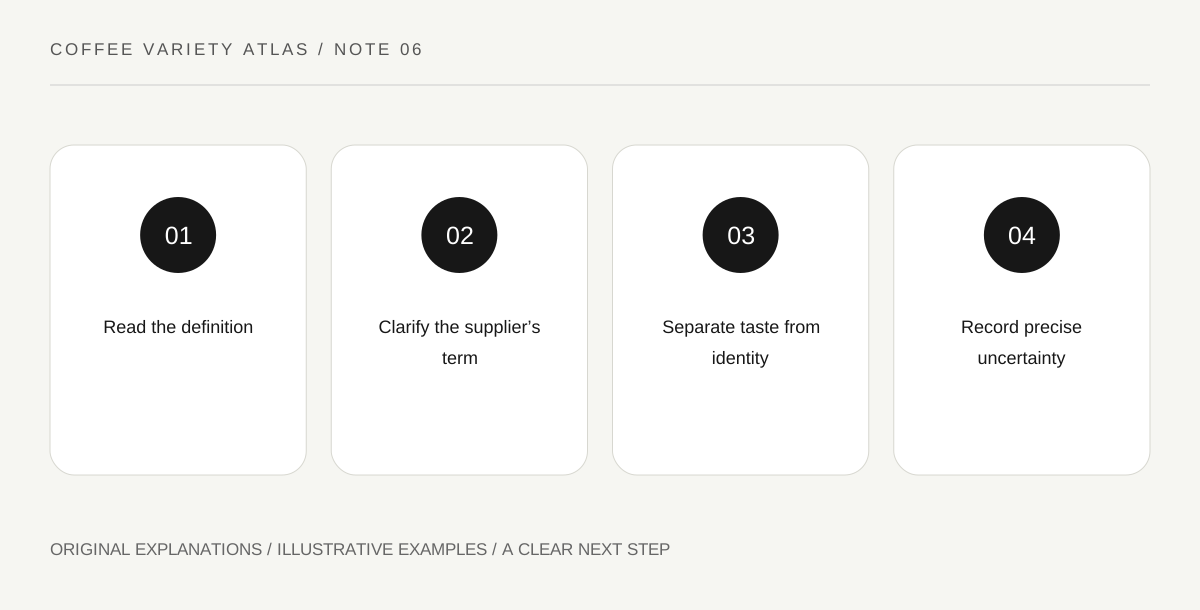
Original explanatory diagram. Read the full method and limitations below.
Begin with a documented definition
World Coffee Research describes an Ethiopian landrace as a domesticated, locally adapted traditional variety associated with Arabica’s Ethiopian origin. That definition concerns plant history and adaptation. It does not mean every lot carrying a broad traditional label is genetically uniform or that its exact composition is known.
Use the definition as a starting framework, then read the actual lot wording. A regional description, local name, named research selection and mixture may convey different information. Do not collapse them into one supposedly complete identity because the package has limited space.
Ask what a broad commercial term means here
If a supplier uses heirloom, ask whether it refers to mixed local material, a known selection or another description. The word alone may leave important detail unspecified. A focused question is more useful than asserting that the label must hide one universal variety called Heirloom.
The supplier may not have finer information. That is an honest limit, not a reason to invent certainty. You can enjoy the coffee while noting that the plant identity is broad. Information quality and your sensory preference are related questions but not the same judgment.
Separate diversity from a flavour promise
Genetic diversity can be important without making every diverse lot taste floral or fruity in the same way. The processed and roasted lot remains the object you experience. Avoid turning a broad population term into a guaranteed sensory profile or a statement that every bean came from identical plants.
Write sensory observations in a separate field from the identity claim. If the cup reminds you of citrus, that is a tasting description. It does not reveal which local selection was present or prove that the supplier’s broad terminology maps to one specific genetic group.
Preserve useful uncertainty in your notes
A good note can say stated as mixed local varieties; further identity not supplied. That is more accurate than copying a familiar variety name from another coffee in the same region. Uncertainty can be specific and informative rather than an empty shrug.
For an exercise, compare fictional labels reading Ethiopian landrace, mixed varieties and a named selection. List what each establishes and one question it leaves open. Keep the exercise about interpretation, not a ranking in which the longest or most technical name automatically wins. The aim is a clear account of what is known about this lot.
Illustrative identity note
A fictional bag says Ethiopian heirloom and names a washing station. The reader records the exact term and asks whether the supplier has more specific plant information. The answer is mixed local material without a finer breakdown. The reader keeps that limit in the notes and describes the cup separately, rather than assigning a named variety based on a flavour association.
Practical checks
Optional checkboxes save only in this browser.
Questions that come up
Is Heirloom one exact coffee variety?
Do not assume that from the word alone. Ask how the supplier is using it and what plant information is available. A broad commercial description may not identify one uniform selection.
Is a broad label necessarily poor coffee?
No. It limits a particular kind of information, but it does not determine your experience of the lot. Keep identity precision and sensory preference as separate observations.
References and scope
These sources support the factual background. Examples and exercises are original illustrative teaching material. References do not imply endorsement.
- World Coffee Research: Geisha, Panama — Gesha/Geisha naming, Ethiopian landrace background and limits of assuming identical material from a name.
- World Coffee Research: International variety-trial definitions — Landrace, genetic group, line, population and F1 hybrid definitions.
- World Coffee Research: Sensory lexicon — Sensory attributes and shared reference vocabulary; tasting language is not an ingredients list.