Read SL28 and SL34 as variety names, not quality scores
Numbers in coffee names can look like ratings or roast codes. SL28 and SL34 identify distinct named varieties instead. Learn to keep those names intact, separate them from a lot’s sensory score or grading language and avoid assuming that a larger number means a better coffee.
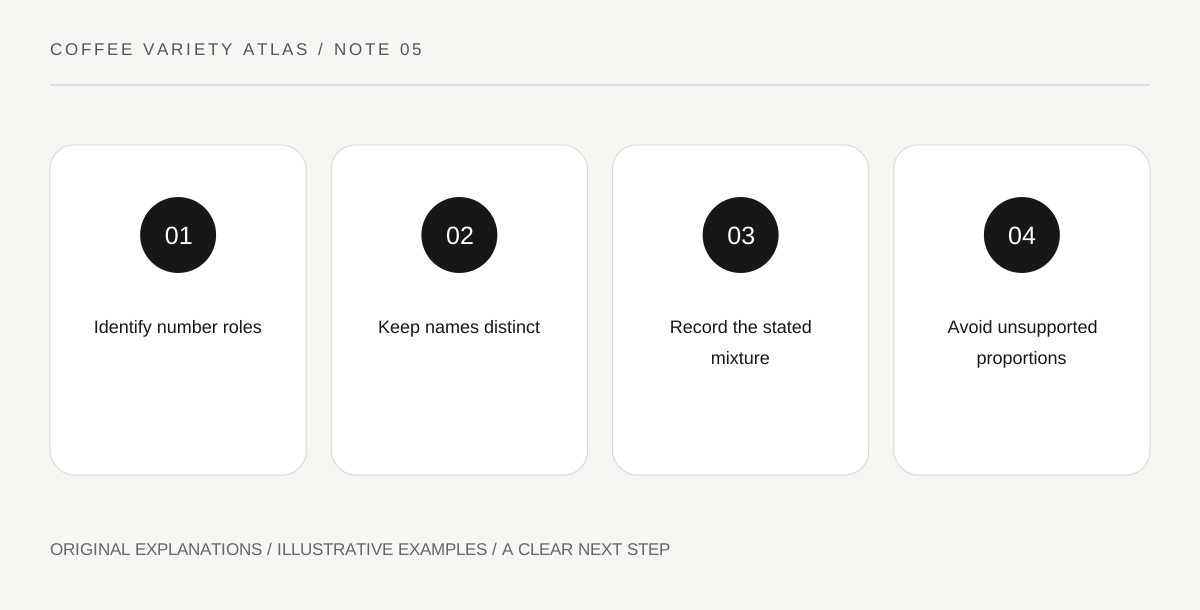
Original explanatory diagram. Read the full method and limitations below.
Identify the kind of number
World Coffee Research lists SL28 and SL34 as separate varieties with their own histories and characteristics. The digits are part of the name. They do not mean 28 or 34 points of quality, a percentage in a blend or a prescribed roast level.
Make a sample label containing a variety name, an elevation and a roast date. Circle each number and state its job. This simple exercise prevents a familiar mistake: recognizing that a number is present without understanding what it measures or identifies.
Do not rank the names numerically
SL34 is not an upgraded SL28 because 34 is larger. A name can reflect a selection history rather than a consumer ranking. Read each catalog entry on its own terms and avoid inventing a sequence in which every later number improves flavour.
Likewise, a variety’s stated agronomic or quality potential is not the score of the particular roasted lot. A producer and roaster work with specific conditions. The cup you encounter cannot be fully predicted by the number embedded in a plant name.
Notice when a lot contains more than one variety
A label may list SL28 and SL34 together, or include other plant material. That is a lot description, not necessarily a single-variety separation. Record the mixture as stated. Do not assign a percentage to each unless the producer actually gives one.
The lot may also carry a regional grade or size term. Keep that in a separate field and check its meaning in the relevant origin context if needed. Different numbering systems can appear on one bag, so sorting their purposes is more useful than treating all figures as a unified scale.
Compare with careful language
If you taste two lots associated with these names, describe the actual observations and other differences. A shared origin does not establish identical farm conditions, processing or roast. The comparison can reveal preference without proving a universal distinction between the varieties.
For an exercise, write a one-sentence summary of a fictional mixed-variety label. Include the names accurately and state that proportions are unknown if they are not supplied. This trains you to preserve useful information while resisting the temptation to make the label more precise than the evidence allows.
When comparing two lots, keep the variety field unchanged in your notes and give each lot a separate identifier. That prevents an attractive cup from becoming an unsupported claim about every tree carrying the same selection name.
Illustrative number sorting
A fictional label reads SL28 and SL34, washed, 1,800 metres, roasted 10 June. A reader places the SL terms under variety, the elevation under growing information and the date under roasting. They do not treat 34 as a higher score or infer equal proportions. Their summary describes a stated mixture with an unknown split.
Practical checks
Optional checkboxes save only in this browser.
Questions that come up
Is SL34 better than SL28?
The number does not establish that. They are distinct varieties, and quality depends on the particular lot and conditions. Use your actual experience and traceability information rather than rank the names numerically.
Does a bag listing both contain equal amounts?
Not necessarily. A list does not supply proportions unless it says so. Record the stated varieties and leave the split unknown instead of assuming a fifty-fifty blend.
References and scope
These sources support the factual background. Examples and exercises are original illustrative teaching material. References do not imply endorsement.
- World Coffee Research: SL28 — SL28 variety identity and selection history.
- World Coffee Research: SL34 — SL34 as a distinct variety, not a score or a roast level.
- World Coffee Research: International variety-trial definitions — Landrace, genetic group, line, population and F1 hybrid definitions.
- World Coffee Research: Sensory lexicon — Sensory attributes and shared reference vocabulary; tasting language is not an ingredients list.